Always-on Displays have been a thing prior to Apple’s announcement, existing for years over various platforms like Symbian, Meego, Windows Phone, and Android. While Apple has consistently been the butt of jokes by debuting “revolutionary” new features that have existed on other platforms for years, this year, it really has managed to show off something that is quite unique. That’s because Apple’s rendition of the Always On Display runs counter to what we have seen and come to expect.
iPhone 14 Pro’s Always On Display is a mere extension of the iOS 16 Lock Screen, and that’s a problem
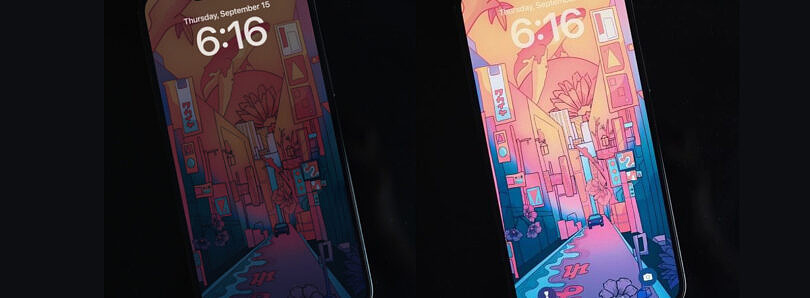
With Apple, you don’t get a sleek and minimal look with small icons that pop up to show you when you have received a new notification. No, that’s just too simple. Instead, you get a Lock Screen display that looks exactly how it does when your phone display is turned on, rendered in full color, with personalized wallpaper, with notifications popping up on the screen like normal. The only difference is that the phone’s display is extremely dim, but this can also auto-adjust depending on the environment.
Much like all other recent Always On implementations, Apple has been able to accomplish this by relying on its new OLED LTPO display that does most of the heavy lifting, with a refresh rate that can go as low as 1Hz. Just for reference, last year’s model only dropped to 10Hz.
So the foundation is here, and Apple had the potential to create something magical, but the experience falls flat rather spectacularly. The Always-on display works, it does all that it promises, but its crux is really where Apple has always struggled. Instead of going all in and really exploring, it robs the feature of its potential because of how restrictive Apple is with its implementation. In this scenario, the Always On Display is only as strong as the information that it can display, and in its current form, it really doesn’t display a whole lot.
In its current iteration, with iOS 16.0.2, the Lock Screen offers three areas that can be customized. The top line can feature one of the following: the date, calendar events, an international clock, an alarm, an activity tracker, and various weather information. Below that is the largest space out of the three, and it’s reserved for the time. The last area is the most versatile and can be loaded with up to four small widgets or two medium-sized widgets. However, the information that can be displayed here doesn’t change much from the first section, but it does have additions, like a battery widget.
In short, the lack of third-party support right now really kills the Lock Screen, which also kills the experience of the Always On Display. It also is rather distracting, taking “Always On” rather literally. Something a bit more subdued and darker would have solved this.
But, there’s actually a bigger issue at hand here, as the new Always On Display on the iPhone 14 Pro has a bigger problem.
Sipping battery like there’s no tomorrow
The biggest issue with the Always On Display is that it compromises battery life. Now, this is something that is to be expected, but for a feature that doesn’t do all that much for me, it felt like a huge trade-off. I think since iPhones are known for having great battery life, this battery drain came as a bit of a shock. I went for the iPhone 14 Pro expecting great battery life, but my experience was literally short-lived, struggling to reach the end of the day — what made it surprising was that the phone had cellular connectivity off and I just relied on a Wi-Fi connection.
While this could be an isolated experience, in my use, I found that the phone lost around an additional 20 percent of battery life when the Always On Display feature was turned on. The iPhone started its day at six in the morning and usually found its way back to a charger at around midnight. Again this could be an isolated finding or have something to do with the current software build, but going through the same schedule for a few days, the results stayed generally the same. Furthermore, there were very few interactions, and notifications were coming in like normal.
I’m not sure how others imagined the Always On Display and Lock Screen, but for myself, I thought it would be more flexible out of the gate, making use of third-party apps and widgets. I also felt that the Always On Display would actually be useful and have more of the information that I needed to see. Maybe it was my fault for having expectations, but in my mind, I imagined it would work almost like an Apple Watch and its complications. Although the customization options on an Apple Watch are limited, it still manages to offer a good experience mainly because it can show you all that you need to see at a glance. The Apple Watch offers lots of app integrations as well, with this data being made available through complications on the watch. I think it’s important to mention that it never felt limiting.
Of course, it’s not fair to compare a new feature with a product that has matured over the course of seven years. The Always On Display and Lock Screen for the iPhone 14 Pro are still in their infancy. If Apple feels like putting energy into it, a lot can change. So for my current use, the Always On Display will remain off, mainly due to battery life issues but also because it isn’t all that useful, to begin with, because it relies on a limited Lock Screen. Maybe when Apple adds support for Live Activities, it will be worth a revisit. But for now, I am turning off one of the headlining features of my new phone.