Last week in Power On: Apple plans a 3D world and video service for its upcoming mixed-reality headset.
The Starters
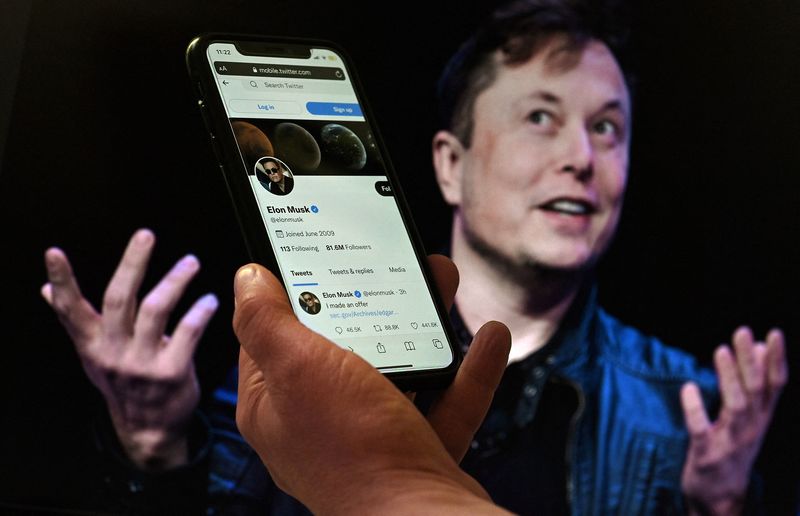
Assuming Twitter Inc. can weather its chaotic start under Elon Musk, the platform is poised to become more of a subscription business—with far leaner operations and less moderation. But that sets the stage for yet another challenge: a possible standoff with Apple Inc. and Alphabet Inc.’s Google over fees and content.
The vast majority of users access Twitter on iPhones and Android devices. Apple and Google safeguard those products and operate the payment systems on their respective app marketplaces. After a botched debut, Twitter plans to relaunch Twitter Blue—a subscription plan that offers verification to any paying customer—at $8 per month on Nov. 29.
That means Apple and Google both stand to benefit: The new Twitter Blue costs $3 more per month than the last version, will likely be heavily marketed and—ideally—offer features that many users will deem worthwhile. That includes Twitter’s famous blue check and the ability to appear higher in search results. If the rollout goes well, it will drive more revenue to Twitter but also to the tech giants.
That’s because both Apple and Google take a commission on subscriptions purchased on their platforms. For Apple, that’s a 30% cut (reduced to 15% after year one per subscriber). For Google, that’s a 15% slice from the beginning.
Twitter is trending toward 250 million daily active users. Let’s assume that 1% of that user base—2.5 million people—subscribe on either iOS or Android. Excluding additional subscription products within Twitter, that adds up to $72 million in year one revenue for Apple and $36 million for Google.
That figure is obviously immaterial financially to either Apple or Google, but could be seen as a costly commission to Musk, who has acknowledged that he overpaid for the social network. The fees, therefore, could put Musk at odds with the app store operators.
The billionaire has long criticized Apple’s fees, calling them a “tax on the internet” and saying they are “10 times higher” than they should be. Even within the last few days, he tweeted that “app store fees are obviously too high due to the iOS/Android duopoly.”
For now, though, Musk has enough to worry about at Twitter without tangling with Apple or Google. The last thing he needs is a battle with trillion-dollar companies.
If he can get Twitter in a more stable condition, I’d expect a war of words to flare up. It may even lead to his company offering Twitter Blue subscriptions via the web, bypassing the required fees when users sign up via the iPhone and Android apps.
Apple already allowed Netflix and business apps to take signups that way, but it hasn’t made the provision for social media. So what happens if Musk attempts to circumvent Apple’s in-app purchasing with Twitter Blue? Such a scenario could set off a Fortnite-like battle.
While Twitter is arguably more critical to society than offerings from Fortnite maker Epic Games Inc., Apple and Google haven’t been afraid in the past to pull apps that the defy their rules.
When Apple removed the Fortnite game from its app store—because Epic was skirting in-app commissions—the company showed it was willing to part with a source of revenue that had generated more than $100 million.
But there’s an even bigger issue than fees that could irk Apple and Google: content moderation. Twitter has fired many of the contractors who worked on policing misinformation and hate speech, and executives overseeing that effort have either fled or been laid off.
Musk has been clear about his desire to increase free speech on Twitter, but that’s brought a downside. In just the last few weeks, some users have seen an increase of racism, antisemitic rhetoric and scams on Twitter.
And Musk’s decision to give verification badges to any paying user—with no real approval process—led to a wave of impersonation. There were fake LeBron James trade requests, an announcement from an imposter Eli Lilly that insulin is now free, and many people pretending to be Musk himself.
With Twitter Blue set for a reboot later this month, the company is trying to iron out these problems. That includes requiring new accounts to wait 90 days to subscribe to Twitter Blue, meaning a troll can’t hop on the platform and instantly start using a blue check to impersonate someone.
But if Twitter can’t get its content-moderation house in order, Apple and Google may step in as gatekeepers. After all, they’ve previously removed social networks, including Parler, from their platforms for that reason. In the case of Parler, the app was ultimately restored to both app stores after the social network followed a series of steps to ensure it was moderating content.
So there are two potential scenarios in which the app stores block Twitter: if it tries to circumvent in-app purchases and if it doesn’t police its content to the satisfaction of Apple and Google. That means the road to Musk creating a successful subscription service runs right through those two tech giants.
Still, I expect Apple and Google to give Twitter an unusual amount of leeway. Twitter’s brand and importance remain strong, and alienating hundreds of millions of users—who are glued to their devices because of the app—would be a losing situation. As would upsetting Musk, who operates two other influential companies, Tesla Inc. and SpaceX. That makes it in everyone’s interest to avoid an all-out digital war.
The Bench
A new Made-in-America push approaches, with Apple looking to Arizona for chip manufacturing. Get ready for another round of Apple touting its US-based investments. The company is planning to diversify its supply chain by getting chips from a new plant set to open in Arizona in 2024. The disclosure was made by Apple Chief Executive Officer Tim Cook in a meeting with employees in Germany, I reported this past week.
“This plant in Arizona starts up in ’24, so we’ve got about two years ahead of us on that one,” Cook said. He added that Apple may also ultimately get chips from Europe as well.
While Cook didn’t say which company would be building the chips, Taiwan Semiconductor Manufacturing Co.—Apple’s current exclusive provider of processors—is building a plant in Arizona and is in talks to open a facility in Germany. So it all points to Apple and TSMC expanding their relationship from Taiwan to elsewhere in the world. In his remarks, Cook said that having the majority of chips being built in one region isn’t ideal.
Chips are the engine behind Apple’s devices, so a shift to US-based manufacturing for processors could be one of its most significant production moves in years. The company made early A-series chips via Samsung Electronics Co. for the iPhone in the US, but switched to TSMC in Taiwan for its more advanced technology around 2014.
TSMC has said that the Arizona plant will initially only manufacture processors built on a 5-nanomater production process at a rate of 20,000 chips per month. That wouldn’t suit Apple’s state-of-the-art iPhone needs by 2024, suggesting either that the factory’s specifications will change or the initial chips will go into less-advanced products, such as AirPods, HomePods, Apple Watches or Apple TVs.
While Apple has many US-based suppliers, nearly all of its devices have their final assembly completed in Asia. And the Pro models of the iPhone are produced almost entirely in one region of China—a state of affairs that’s brought recent headaches. The rare exceptions to Asian final assembly involve the Mac Pro in Texas and some older iPhone production in Brazil. But the Mac Pro hasn’t been updated in three years, and Apple still isn’t making newer iPhones outside of Asia. So the company is only in the early stages of decreasing its reliance on the region.
Apple looks to boost Mac sales with aggressive discounts aimed at small and midsized businesses. In a rare move, Apple is stepping up its discounts for business customers that buy in bulk. In what it has termed a “very special” campaign, the company is offering businesses 8% off when they buy 5 to 24 of the 14-inch and 16-inch MacBook Pros and 10% off when they purchase at least 25.
The deal runs until the day before Christmas and that’s no coincidence: Apple was very clear on its most recent earnings call that its growth rate in the holiday period will slow in comparison to the previous quarter due to the Mac. The revamped MacBook Pro launched in October 2021, and there’s no similar debut happening during the holiday quarter this year.
The rare promotion is clearly an attempt to keep Mac sales flowing despite the lack of new products. It also may help clear out inventory before the next-generation models with M2 Pro and M2 Max chips arrive. As I’ve written here before, those machines are well into testing and I expect them to launch around March.