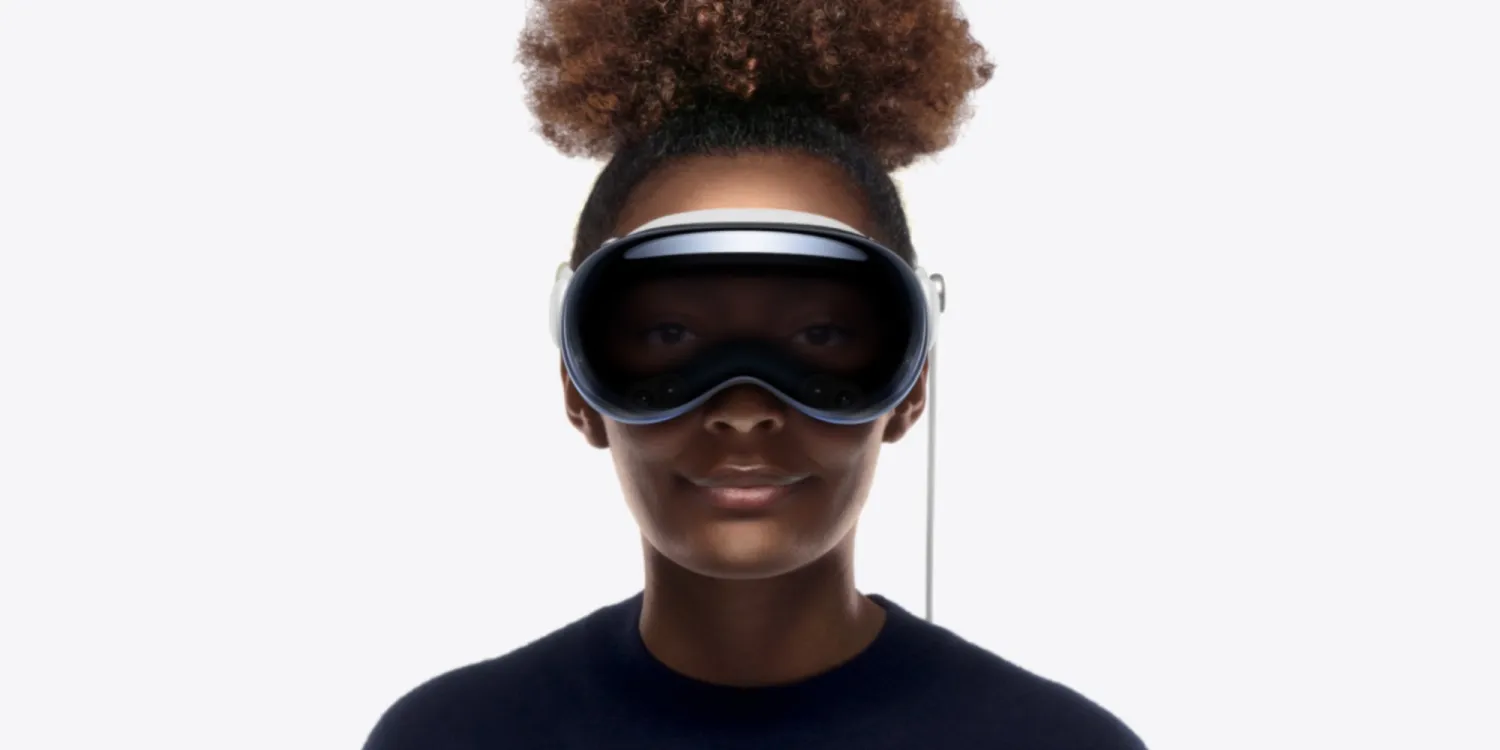
In short, time using Vision Pro is time not being engaged with your community. Go to the office, go to the grocery store, go to the concert, go to the gym. I’m very sympathetic with this area of thinking. As a remote worker and single parent of five- and ten-year-old kids, the opportunity to meet new people ain’t what it used to be. An ad for Peloton followed the segment. Huh. Anyway…
Vision Pro has the potential to connect us in new ways, but the risk of adding to the loneliness epidemic with mass virtual reality usage is equally present.
Sticker shock beyond expectations
The idiom sticker shock, coined in the U.S. in the 1980s, refers to the feeling of disgust or fright experienced upon learning a product’s price.
I know I felt it when we learned that the Apple Watch Edition would cost as much as $18,000. It’s a feeling I felt as a kid when realizing how incomprehensibly large the universe is based solely on my inability to count the stars in the sky. It was rural Alabama with zero light pollution; there were a lot of stars.
If you’ve followed reporting around Vision Pro before the official announcement, you’ve probably expected the headset to cost upwards of $3,000. There was even a point when the $3K price was discussed as being for some sort of app development hardware and not an actual consumer product. It will certainly be used that way for some, but that was not the pitch.
Instead, Apple did the iPad thing and went with a price $500 from the rumor. In the case of the iPad, the press expected the tablet to start at $999. Apple wowed everyone when it actually started at $499. Vision Pro does the same thing – just in the opposite direction.
The headset starts at $3,499, and that’s before you factor sales tax (~$280) and corrective lenses (let’s guess ~$220), if needed. That’s a neat $500.
Seriously, I’m considering a GoFundMe for $4,000 to cover the cost of evaluating Vision Pro. Kidding, maybe. But like the number of stars in the sky, the initial sticker shock makes the price feel astronomical.
Bang for the buck
A $1,200 MacBook and a $1,200/year internet bill lets me earn a living. Vision Pro appears to be an awesome way to extend a MacBook beyond its screen capacity. That’s the most frequent day-to-day usage I would predict for me. That and watching movies.
Yet it’s difficult to justify a purchase in good faith that’s worth a quarter year’s rent and could age as well as the first-gen Apple Watch. Granted, Vision Pro does have a super capable Mac processor inside while the original Apple Watch tested the limits of miniaturized computing.
Still, I have a feeling that we should think of Vision Pro more as an iPad with an M2 processor and not a MacBook with an M2 processor. If you prefer the iPad over the Mac, you’ll hate that comparison. If you feel hamstrung by the iPad and thrive on the Mac, you’ll understand.
Considering the value is hardly a knock against Vision Pro and what it will do as a product.
I do think the 2-hour battery life and apparent inability to swap batteries without shutting down Vision Pro will be the signature critique in reviews next year, but maybe we’ll be surprised and delighted when it arrives in early 2024.
Four grand is just the literal cost of Vision Pro. But if you remove the price tag, perhaps with a lower-end version, there may still be a price on mental health that we must consider.
No one worried about “screen time” in 2007
When the original iPhone launched in 2007, tech columnists didn’t wonder what negative effects an all-encompassing mobile device could create in our lives. Eleven years later, Apple shipped a feature called Screen Time to help customers monitor device pervasiveness – and serve as a response to press pushing for accountability over digital addiction.
Things are different now. We know how addictive screens can be for kids and adults alike. We experienced the COVID-19 pandemic and the isolation that it brought. Even before COVID, we sought moments when we could feel more present and less split between worlds.
The U.S. Surgeon General even published an 82-page report on the epidemic of loneliness and isolation. It’s a real problem brought on by modern society and technology.
A palm projector in a T-shirt pocket hardly seems like a practical solution. (Sometimes stealth startups by Apple veterans end up being kind of boring acquisition targets that eventually evaporate.)
More agency in device usage and saying yes to in-person experiences helps.
Virtual versus reality
I have a hard time maintaining long-distance relationships. Whether it’s friends or family, I see diminishing returns when investing in relationships that primarily occur through the phone. Time actually spent together provides a lot more runway for how long I’m willing to maintain a connection.
I worry this makes me a jerk and a bad friend, but I accept that it’s how I’m wired. I need in-person interaction to stay engaged. Time spent not in service of in-person interactions feels like opportunity wasted. This is why I only find joy in playing video games with my kids. If a Vision Pro headset fell in my lap, I worry it could provoke this same sense after the initial excitement of exploring a new platform.
My favorite memories are of in-person experiences shared with other people.
Milestones with my kids. Taking family to NFL games and cheering with strangers around me. Attending NBA games with friends after sharing a meal and nearly forgetting to leave in time for tip off. Going to concerts with past partners and being surrounded by strangers who I know love something I love. Running 10K races and half marathons with hundreds of other runners who motivate me to keep going.
Memories of digital experiences are next to impossible to recall for me. Still, I can foresee a future where I prefer attending virtual concerts and sporting events because it’s just easier. Maybe even to feel better about having bought the headset after the initial review. In the past, I’ve been willing to jump through hoops to arrange travel, lodging, and babysitting to go places that end up fostering magical moments. The cost of Vision Pro could be that we’re less willing to make something that feels impossible actually happen.
Escapism is not new
Mixed reality is hardly creating new experiences. Instead, it’s creating more convincing versions of experiences we already seek. We want to be entertained and engaged by film. We want to feel on the same wavelength with others through social media.
A Peloton stationary bike with a live video instructor and a hundred other riders competing from home is not unlike Vision Pro. You’re encouraged to stay put, reducing opportunity for meeting your future partner or a new friend who goes to the same gym.
At the same time, you may improve your heart health in a way that you otherwise wouldn’t make time for. Just keep in mind the impact that loneliness can have on long term physical health.
And there are countless ways to be less engaged in our communities.
Having groceries delivered reduces the opportunity to experience kindness from a stranger or spread kindness yourself. Sometimes it’s a compliment from someone we don’t know that makes your day or week. I can make coffee at home, but my Keurig isn’t going to tell me it likes my tattoos like the barista always does. Moments of connection like those are harder to come by in isolation, but not impossible thanks to the internet.
An absolutist protesting the very idea of Vision Pro in favor of community interaction would need to consider throwing out the television and abandoning the internet. Give up reading books and befriend the storyteller instead. Admittedly, I like the sound of it, but it’s impractical and doesn’t easily scale.
Instead, we seek balance.
Social media platforms contribute to depression. The recommended solution, however, is moderating time spent on social media. Eliminating social media usage altogether can contribute to isolation and feeling less engaged in a community.
With Vision Pro, Apple seems to be walking a tight rope with what it says and doesn’t say. It’s not augmented reality or virtual reality, it’s spatial computing. You’re not using an avatar as your digital representative, it’s your Persona. You’re not flooding your vision with a video feed of the forest, you’re in an Experience. Finding balance in how to market Vision Pro seems as hard as finding balance in using Vision Pro.
Maybe, ultimately, the cost of Vision Pro on mental health is up to us. Discussing healthy strategies early on before “spatial computing” takes us out of our reality on a more regular basis can only help.
Extending the metaphor
Like it or not, there’s a good chance that Vision Pro will forge a path for a future of products like it to exist (and not the Nintendo-esque game console-equivalent headsets on the market today). Being aware of how virtual reality usage affects our kids’ development and our own mental health is paramount.
Despite a roadblock of a price tag, Vision Pro is more than likely only the start of a new platform that will define the rest of this decade. The choice of two hour battery life or being anchored to a power adapter will fade with the march of technology. Hardware will become more like jewelry and less like science-fiction over the decade.
Back to the professor and his unrivaled bearishness for Vision Pro. “I believe the Vision Pro will be remembered as a Neanderthal, an evolutionary dead end — a heavy, thick-browed experimental species destined for extinction,” Scott Galloway writes.
Steve Jobs similarly once referenced evolutionary development to describe the potential of computing more generally. “I think one of the things that really separates us from the high primates is that we’re tool builders,” Jobs said.
“I read a study that measured the efficiency of locomotion for various species on the planet. The condor used the least energy to move a kilometer. And, humans came in with a rather unimpressive showing, about a third of the way down the list. It was not too proud a showing for the crown of creation,” Jobs continued.
“So, that didn’t look so good. But, then somebody at Scientific American had the insight to test the efficiency of locomotion for a man on a bicycle. And, a man on a bicycle, a human on a bicycle, blew the condor away, completely off the top of the charts,” Jobs explained.
“And that’s what a computer is to me. What a computer is to me is it’s the most remarkable tool that we’ve ever come up with, and it’s the equivalent of a bicycle for our minds.”
Extending the metaphor, Vision Pro may be the equivalent of a Peloton stationary bike for our minds. It will take us to places without leaving the comfort (and confines) of our homes – we just have to remember to actually leave home and participate in community too.