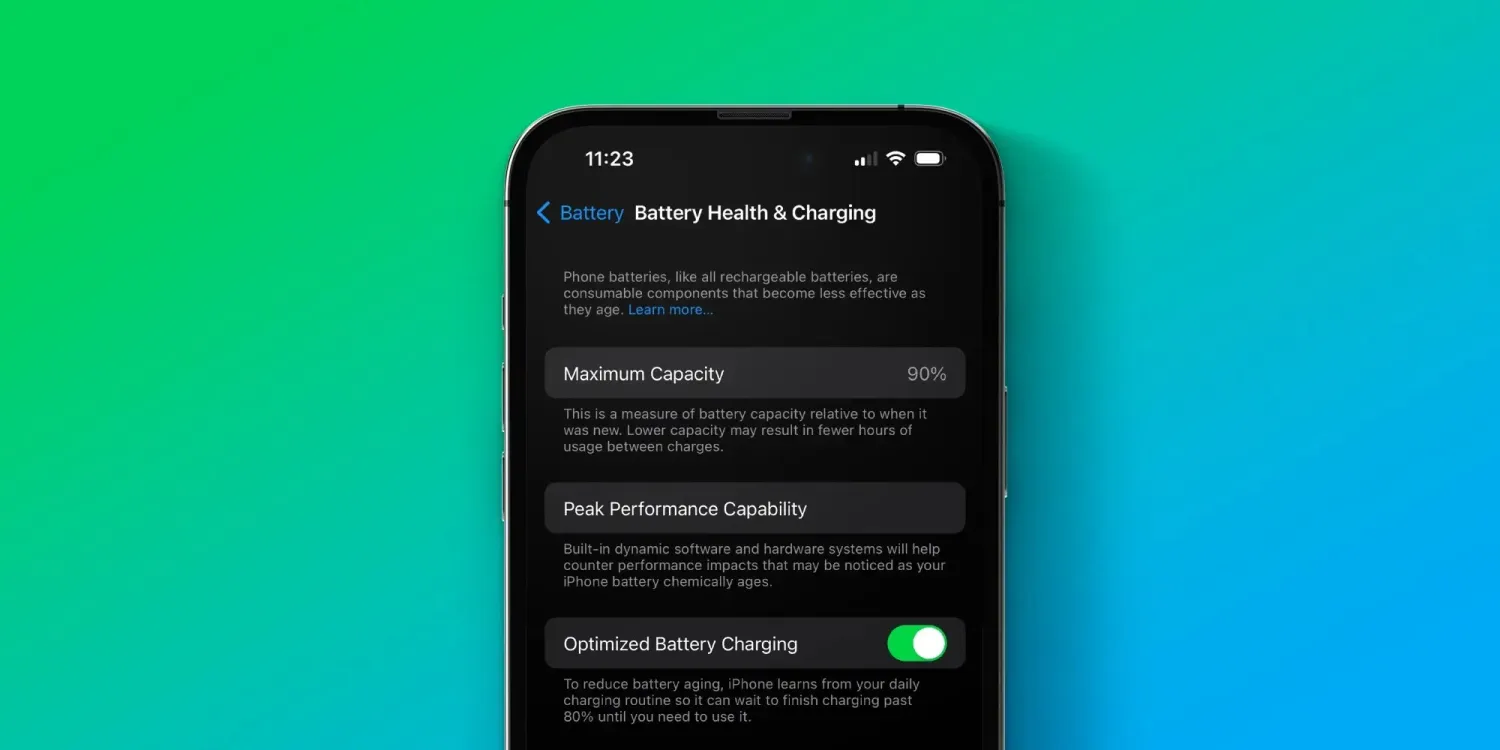
Apple added the “Battery Health” feature to iPhones starting with iOS 11.3 in March 2018. The feature came in response to the so-called “Batterygate” scandal. At the time, Apple confirmed that it had been silently throttling iPhone performance as batteries aged over time, so the “Battery Health” menu was added to Settings to give users more context on their iPhone’s battery.
iPhones use lithium-ion batteries, which chemically age throughout the device’s life cycle. In a support document, Apple explains that as the battery ages, the amount of charge a battery can hold diminishes. In turn, this results in shorter amounts of time before a device needs to be recharged.
Apple says iPhone batteries are “designed to retain up to 80% of its original capacity at 500 complete charge cycles when operating under normal conditions.”
The battery health of an iPhone can also impact performance, and iOS has measures in place to balance performance and battery health. Apple explains:
The power needs of iPhone 11, iPhone 11 Pro, iPhone 11 Pro Max, and later are dynamically monitored, and performance is managed so that it can address these needs in real time. The system is more advanced than previous iPhone battery and power management systems and allows your iPhone to reduce performance impacts from battery aging
While performance impacts are reduced as much as possible, battery aging might still eventually lead to noticeable, possibly temporary, effects. Depending on the battery state and the tasks that your iPhone is handling, examples might include longer app launch times, lower frame rates, reduced wireless-data throughput, backlight dimming, or lower speaker volume.
The balance between performance and battery health is managed by iOS. “Built-in dynamic software and hardware systems will help counter performance impacts that may be noticed as your iPhone battery chemically ages,” Apple says.
iPhone 14 Pro’ Maximum Capacity’ battery concerns
Over the last several months, a growing number of iPhone 14 Pro users have taken to Twitter and other social media platforms to share screenshots of their iPhone 14 Pro battery’s “Maximum Capacity.”
- Aaron Zollo: 90% max capacity
- Apple Hub: 89% max capacity
- Lon Siedman: 88% max capacity
- Jon Rettinger: 90% max capacity
- MilesAboveTech: 86% max capacity
- Robert Rosenfeld: 93% max capacity
- Andrew Clare: 90% max capacity
- TechDaily: 89% max capacity
- Matou Ecureuil: 88% max capacity
- Brandon Butch: 91% max capacity
This number can be found by going into the Settings app, choosing “Battery,” then tapping “Battery Health and Charging.” Apple says this number is a “measure of battery capacity relative to when it was new.” As such, “lower capacity may result in fewer hours of usage between charges.”
There are a few possible reasons as to why users are seeing a change in their iPhone 14 Pro’s “Maximum Capacity” rating. First, it could be that Apple adjusted the algorithm for how this number is calculated compared to previous iPhone models.
It could also be that the iOS 17 beta has had an abnormally large impact on iPhone battery health. As always, things like power and battery management are less refined in beta versions of iOS than in versions released to the general public.
Another possibility is that features exclusive to the iPhone 14 Pro, such as the Always-On Display, are impacting overall battery health. The iPhone 14 Pro’s display can also reach 2000 nits peak brightness in outdoor environments, nearly double that of the iPhone 13 Pro.
Still, Apple hasn’t directly commented on these complaints from iPhone 14 Pro users, so this is all conjecture for now. In general, the company recommends battery replacements when “Maximum Capacity” falls below 80%. Less than one year after the iPhone 14 Pro’s release, some users are getting surprisingly close to that threshold.
iPhone battery replacements are covered as part of the one-year warranty included with every new iPhone purchase as well as for iPhone models covered by AppleCare+ plans (provided that the iPhone’s battery health is below 80%).
If your device is out of warranty or if you want a battery replacement before it falls below 80%, here are replacement prices:
- iPhone 14: $99
- iPhone X, iPhone 11, iPhone 12, and iPhone 13: $89
- iPhone SE, iPhone 8, and earlier: $69
Apple battery replacement can be performed at Apple retail locations through the Genius Bar, online using mail-in service, or at authorized resellers.