Last week in Power On: Apple will put its reputation on the line with the upcoming mixed-reality headset.
The Starters
Apple Inc. Chief Executive Officer Tim Cook, speaking on an earnings call that was mostly focused on holiday results, made an off-the-cuff remark that could be quite telling about the company’s future.
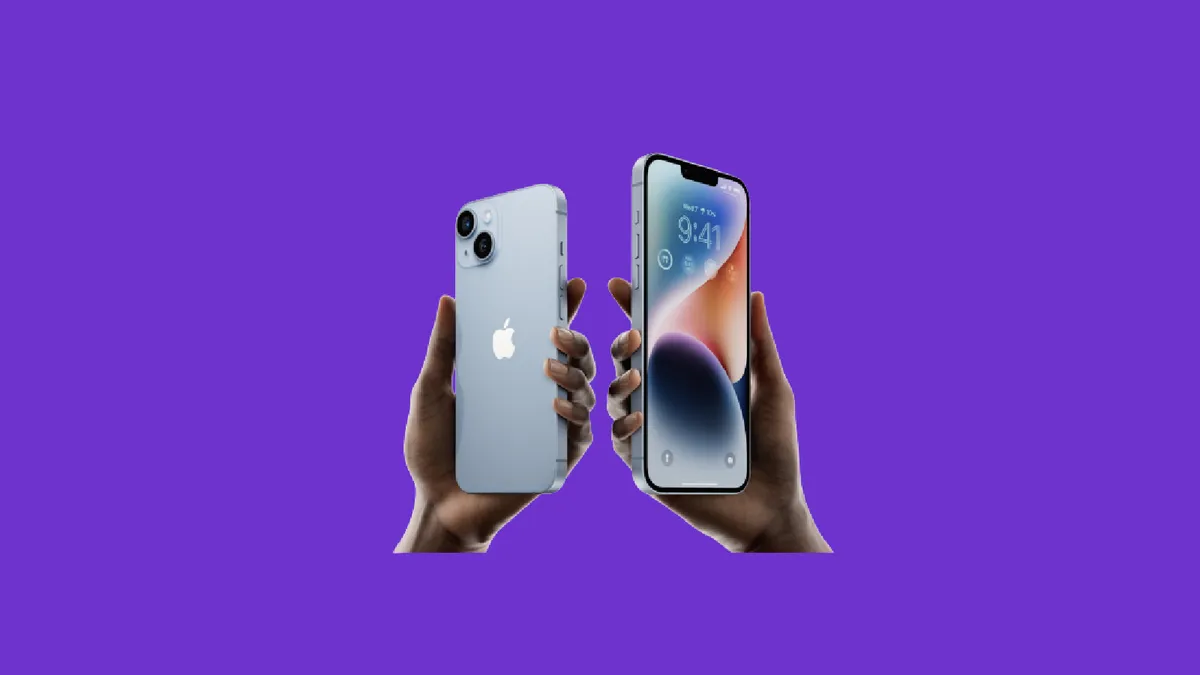
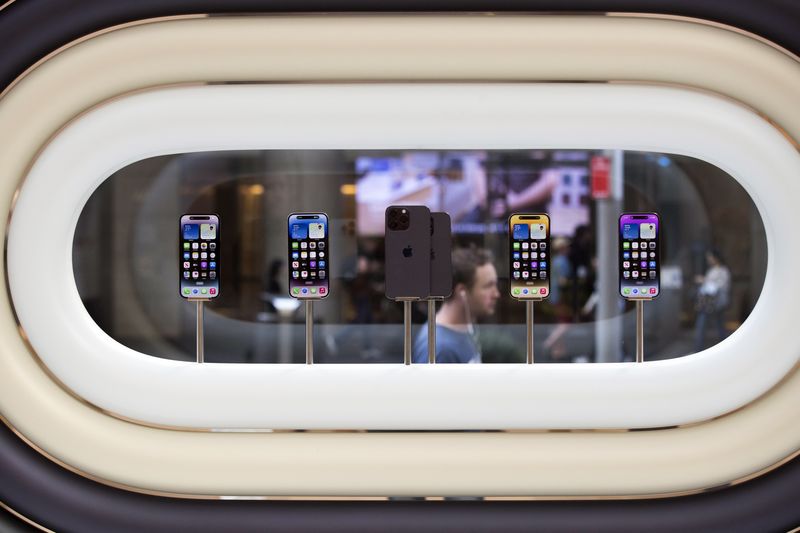
Cook was fielding a question about whether the iPhone’s rising average sales price was sustainable. After all, a top-of-the-line model that cost $1,150 in 2017 (the iPhone X with 256 gigabytes of storage) now fetches $1,600 (the iPhone 14 Pro Max with 1 terabyte).
His response: The price increase is no problem. In fact, consumers could probably be persuaded to spend more.
“I think people are willing to really stretch to get the best they can afford in that category,” Cook said on the call, noting that the iPhone has become “integral” to people’s lives. Consumers now use the device to make payments, control smart-home appliances, manage their health and store banking data, he said.
While Cook wouldn’t say if he anticipates further price increases, he made a good argument for why even more upscale iPhones could make sense — especially if they deliver new features.
Apple has internally discussed adding a higher-end iPhone to the top of its smartphone lineup. And it’s already been doing more to distinguish its Pro models from standard iPhones, giving consumers a reason to pay up.
When the iPhone 15 arrives later this year, Apple will further differentiate the product’s tiers with a range of materials, processors and cameras. That includes giving the Pro Max model a periscope lens, which will offer improved optical zoom.
Apple’s plan to draw a greater distinction between the Pro and Pro Max has spurred speculation that the company will opt for a new top-end brand: the Ultra. Apple has already used that name for its sporty high-end smartwatch and the top version of the M1 processor.
But instead of renaming the Pro Max “the Ultra,” Apple could add an even higher-end iPhone above both Pro models. Internally, the company has discussed doing just that — potentially in time for the 2024 iPhone release.
That could certainly drive up prices, but consumers would need a reason to upgrade. At this point, it’s unclear how that top-of-the-line model would be different, but it will probably offer further camera improvements, a faster chip and perhaps an even larger display. There also may be more future-forward features, such as finally dropping the charging port.
Samsung Electronics Co. has already embraced this approach with its own Ultra phone — a model that offers more cameras, a bigger battery, a larger screen, stylus support, additional memory and a different design.
Moreover, Samsung offers two types of foldable phones, which have increasingly become the focal point of its smartphone strategy. Apple has explored a foldable iPhone in the past, but I wouldn’t anticipate one launching in the near future. For now, the company is focused on larger foldable devices — something the size of a laptop.
If Apple were to sell a foldable iPhone, the price would clearly be higher than that of its current models. Such a device would require far more advanced technology for batteries, displays and chips. Samsung’s priciest foldable — the Z Fold4 — costs as much as $2,160.
It may be quite a while before Apple customers have a chance to actually purchase an “iPhone Fold.” But if Cook’s comments are any indication, many will happily spend the money.
The Bench
Apple drops role of industrial design chief after struggling to find a long-term replacement for Jony Ive. Evans Hankey, Apple’s head of industrial design, took that job when Jony Ive left the company in 2019. But she only lasted about three years in the role, sending Apple scrambling to find a successor. As I reported in November, it’s been a difficult task.
Sure enough, Apple has now decided that it simply won’t replace her. Instead, the company’s team of about 20 senior industrial designers will report to Chief Operating Officer Jeff Williams.