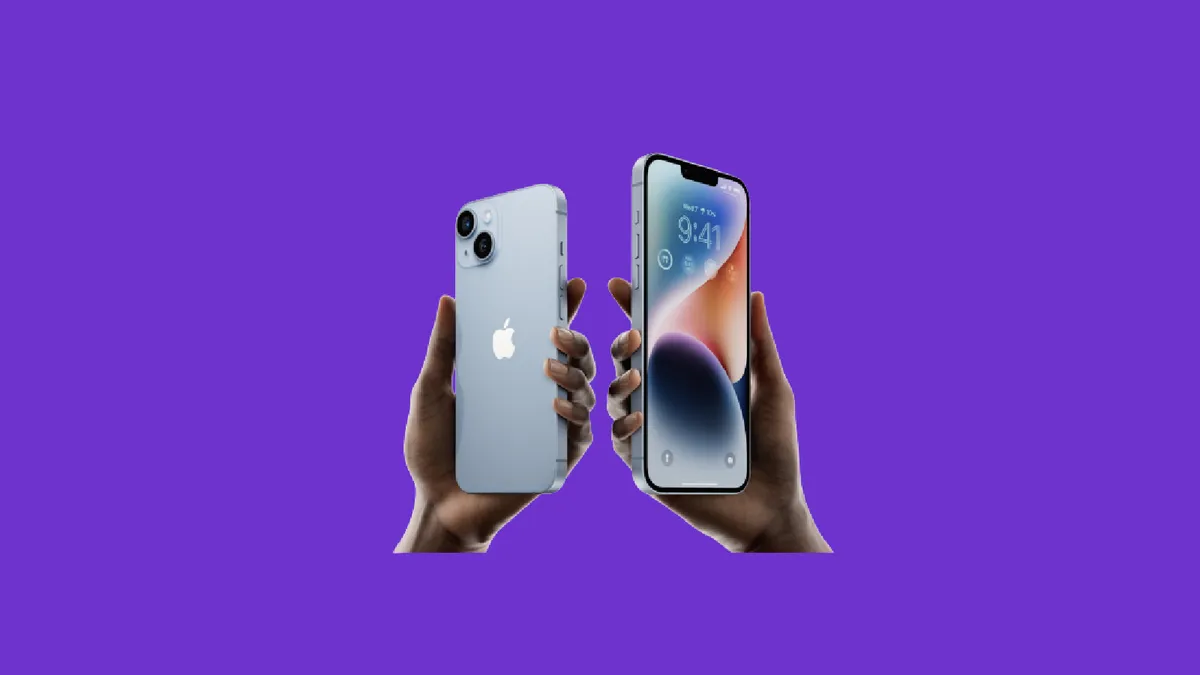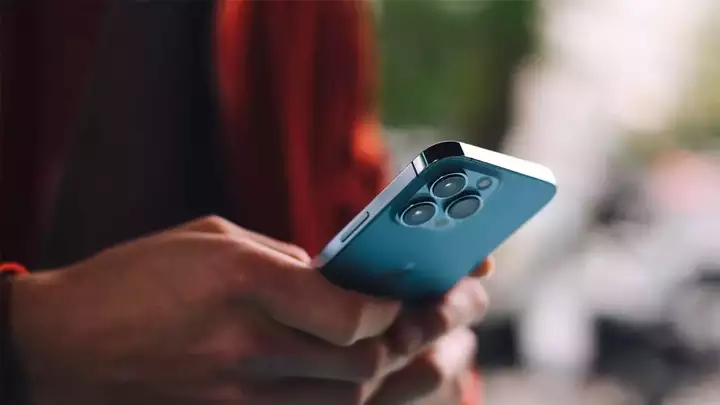
The iPhone enters the next round with the iPhone 14 Pro succeeding last year's iPhone 13 Pro. As with each new generation, Apple uses a new SoC, improved cameras, and the latest iOS version, while retaining the form factor this time around. The camera upgrades are particularly interesting this year, since the Californians are using a 48-MP main sensor and the pixel binning technology for the first time.
Case - iPhone 14 Pro now without a Notch
The iPhone 14 Pro comes in four different colors: Space black, silver, gold, and deep purple. The cameras on the back now protrude even further from the case at 4.15 mm (~0.16 in). On the iPhone 13 Pro, the bump was slightly smaller at 3.75 mm (~0.15 in). This results in the smartphone wobbling around quite a bit when set down on a table or other flat surfaces. With 3 g more, the new iPhone is also slightly heavier.
The build quality and the materials of the iPhone 14 Pro are outstanding. The clearances are extremely tight and even. While the smartphone is also very resistant to twisting attempts from the corners, there was some creaking from the inside. Both the front and the back consist of glass with the latter being matte. Although this results in great haptics and optics, it also turns the phone into a fingerprint magnet. Fingerprints quickly and visibly accumulate even on the matte back. The same holds true for the polished, high-gloss stainless steel frame.
The notch is dead, long live the Dynamic Island. It consists of not one, but two hole-punch interruptions in the display that contain the front camera, Face ID, and other sensors. The software visually combines both areas into one, creating the Dynamic Island. When the display becomes very bright, the contrast drops and the edges become visible. Speaking of which, they are fairly wide, particularly compared to other manufacturers' solutions.
The physical buttons seem to be of high quality and they are attached firmly. Travel is not too shallow, but crisp and precise. The SIM slot, which is still included on our European model, sits flush within the frame. The internal sim tray consists of metal and is able to hold one nano SIM card. The iPhone 14 Pro continues to feature an IP68 certification, signifying dust and water protection. According to Apple, the latter is guaranteed up to a depth of six meters (~20 ft) and for up to 30 minutes.
In terms of maintainability, our collegues over at iFixit gave the iPhone one of the best scores in a long time (7/10). They were pleased with the complete internal overhaul of the smartphone and the resulting longevity and environmental benefits. This does not apply to the Max model, however. A full product environmental report is available on Apple's official web page.
Connectivity - Still no USB for the iPhone
The Apple iPhone 14 Pro continues to rely on the Lightning connector for wired data transfers and charging. Since the transfer rates correspond to the USB 2.0 standard, large file transfers and local backups take up more time. Video and audio adapters can be connected to the smartphone via optional accessories.
Users who like taking videos with their iPhone should skip the smallest variant. The video quality of the 128-GB model is limited to Full HD at up to 30 FPS when ProRes is enabled. On the 256 GB models and above, the mode also supports up to 60 FPS or Ultra HD at up to 30 FPS. Thankfully, at least the cinema mode comes without any restrictions.
Bluetooth 5.3, NFC, UWB, and MagSafe are supported. MagSafe refers to a magnet on the back of the smartphone used to attach accessories and charging docks.
Software - iOS 16, Dynamic Island, and Always-on
The Apple iPhone 14 Pro comes with iOS 16 and has already received two updates containing bug fixes during our testing, which makes our iOS version at the time of testing 16.0.2. The new operating system is expected to become available for all models down to the iPhone 8 and 8 Plus, making all iPhones released within the last five years up to date. Since certain features rely on new hardware, not all new features will be available on the older models. Although there has not been any official statement from Apple, users can most likely expect similar update support on the iPhone 14 Pro.
While there have been no major design changes to iOS, the lock screen is now more customizable. For example, live activities allows users to display ongoing events without having to unlock the iPhone. The functionality of widgets and the focus mode has also been expanded. The dictation feature now automatically inserts punctuation and allows for the use of emojis. The home app has been completely revamped and now supports the smart home standard "Matter".
The Dynamic Island is a new software solution designed to mask the punch holes in the front display and present information of currently active apps in a space-efficient manner. This works well during use and is very practical. While the feature is still mostly limited to Apple's own apps at the time of writing, other app developers are also able to access the inferface. The iPhone now features an always-on display, which can be customized to your liking. Although this is not exactly a groundbreaking new feature, it is practical and its implementation excellent.
A detailed overview of all the new features of iOS 16 is available directly from Apple. When the Dynamic Island is disabled, the interruptions in the display from the camera holes are hidden.
Communication and GNSS - iPhone 14 Pro without Wi-Fi 6E
The Qualcomm Snapdragon X65 5G Modem-RF System ensures an optimal mobile connection with a very wide range of supported frequency bands and transfer rates of up to 10 Gb/s. mmWave 5G is exclusively supported by the US models. The same holds true for the emergency call feature via satellite. The crash detection feature is available on all models and able to call emergency services if when it recognizes dangerous situations, although this does not appear to work flawlessly under all circumstances.
The Wi-Fi module is not quite up to the latest standards, since it does not support Wi-Fi 6E and the associated 6-GHz band. In addition, the transfer rates within the 5-GHz network of our Asus ROG Rapture GT-AXE11000 reference router are somewhat slow, but at least consistent in both directions.
Telephony and Call Quality
The call quality of the Apple iPhone 14 Pro when put up against the user's ear is excellent in quiet environments and voices sound very natural. When ambient noise, such as the voices of people in the background is introduced, they are audible for your conversational partner for a short period of time and subsequently filtered out. Near main roads, this process takes significantly longer, noise fragments can still occasionally permeate the conversation, and the voice of the user can become distorted.
Since ambient noise is not filtered by the iPhone while on speakerphone, this mode should ideally be reserved for quiet environments. While our voice sounds more dull in this case compared to when the phone is held up to your ear, it still sounds fairly natural despite some small disturbances which made their way into our sample calls, particularly when the smartphone was very close to the user. The range of the microphone is good and captures our voice at almost the same volume from two meters (~6.56 ft) away.
The iPhone supports VoLTE and Wi-Fi calling. Our test device accepts a nano SIM card. Additionally or alternatively, there is an integrated eSIM. Devices sold in the US no longer come with a physical SIM slot and instead offer dual eSIM support.
A lot has changed in terms of the cameras of the iPhone 14 Pro. Starting with the front camera, the sensor still has a resolution of 12 MP, but now features a nominally more light-sensitive f/1.9 aperture and an autofocus. This results in good selfies even in low-light situations. The front shooter even supports RAW capturing and goes all out when it comes to video recording. Videos can be captured at up to Ultra HD with up to 60 FPS including Dolby Vision, in ProRes (4K @30 FPS, 1080p @60 FPS), or using the cinema mode.
While this is nothing new for Android users, this iPhone marks the first time Apple uses a 48-MP main camera with pixel binning, which combines four pixels into one large pixel. Experience shows that this results in both better pictures under poor lighting conditions as well as more detailed images. Users are limited in terms of choosing the image size, which is fixed at 12 MP. The RAW mode is an exception and also offers a 48-MP option. Furthermore, the main sensor features an optical image stabilization with second-generation sensor shifting.
We are pleased with the image quality under daylight, which is defined by a balanced composition with fine details, a warm color balance, and natural colors. In the dark, differently lit areas are captured accurately, although the post processing tends to exaggerate the contrast when attempting to reduce image noise. Overall, the iPhone is able to capture many details under low-light conditions, provided the camera app is allowed to automatically increase the exposure time slightly. While some users are reporting issues with HDR capturing, we were not able to reproduce this problem so far.
A 3x optical zoom lens with traditional optical image stabilization (OIS) is the foundation for enhanced shots. For pictures at 2x zoom, Apple still relies on the digital zoom of the main sensor, which results in significantly better pictures at this zoom level compared to the iPhone 13 Pro. At slightly higher zoom levels, the camera setup of the iPhone 14 Pro still performs admirably, although the quality quickly deteriorates at higher magnifications with 15x being the maximum zoom available.
The ultra-wide lens continues to rely on a 12-MP sensor, whereas many competitors offer higher-resolution ultra-wide cameras, which is also apparent in a direct comparison of the pictures. Conveniently, the camera app can automatically switch to the included macro mode, which is also accessible via an optional toggle. Depending on the lighting conditions, While the colors of the main and macro sensors on the iPhone 13 Pro would often vary, Apple claims to have fixed the issue. The solution appears to be a partial success, although there are still noticeable differences.
The video mode is able to benefit from the improved image stabilization and the cinema mode now finally supports Ultra HD at up to 30 FPS. While the mode has been further improved, calm sequences without a lot of movement or a clearly visible focus element may result in the autofocus getting confused and shifting the layer of focus. The camera of the iPhone 14 Pro offers a great deal of flexibility in terms of the available video formats and optional Dolby Vision. Only 8K recording and aspect ratios other than 16:9 are unavailable still.